 NomadSwipe
How to plan a weekend city break: a 48-hour checklist
Here is how to plan a weekend city break: choose your two days first, then swipe a shortlist of real places, cluster it on a map and book only fixed-time items. In five NomadSwipe city decks, 6% of places with stored hours are closed Saturday and 19% Sunday.
The checklist at a glance
A weekend city break gives you two days on the ground, so the planning is mostly about not wasting one of them on a closed door. This is the order I would work in.
| When | Do this | Step |
|---|---|---|
| Before you pick flights or trains | Choose which two weekdays you will be there, using closing patterns | 1 |
| Before you book a bed | Pick a base and a daily radius | 2 |
| At home, with the app | Search the city, swipe a shortlist, check the blanks, cluster it on the map, build the trip and pin your hotel | 3 to 6 |
| Straight after the shortlist | Book the fixed-time items | 7 |
| The day before | Recheck hours, open the trip online once | 8 |
The 8 steps
-
Pick the two weekdays before you book anything.
Closed days are not spread evenly. In the five NomadSwipe city decks that state every weekday, 98 of 1,675 places with stored hours (5.9%) show Saturday as closed, 19 (1.1%) show Friday and 312 (18.6%) show Sunday, with Monday at 321 (19.2%). If you can choose, Friday and Saturday are the least risky pair, and a Saturday and Sunday weekend carries one risky day. The tables further down show the numbers city by city.
-
Choose a base and a daily radius.
One neighbourhood per day keeps a short trip short. In my Chicago in 2 days guide the two stops farthest apart on a day are 3.0 km and 1.7 km apart by straight line, and in Buenos Aires in 2 days they are 1.5 km and 3.9 km apart. Those are my picks, not a standard, and straight-line figures are not walking times. Pick a centre such as a main square or your hotel and keep each day close to one point. The method for finding that centre is in how to find things to do in a new city.
-
Search the city and swipe a shortlist.
In NomadSwipe you open a city and get a deck of real places nearby: sights, food, museums, nights out. Each card shows its category, rating, distance and opening status. Swipe right or tap Save to keep a place, and swipe left or tap Skip to pass. Deciding yes or no on one card at a time is faster for me than building a list by searching. For a weekend, aim to save a few more places than you need, because some will fail the weekday check in step 4.
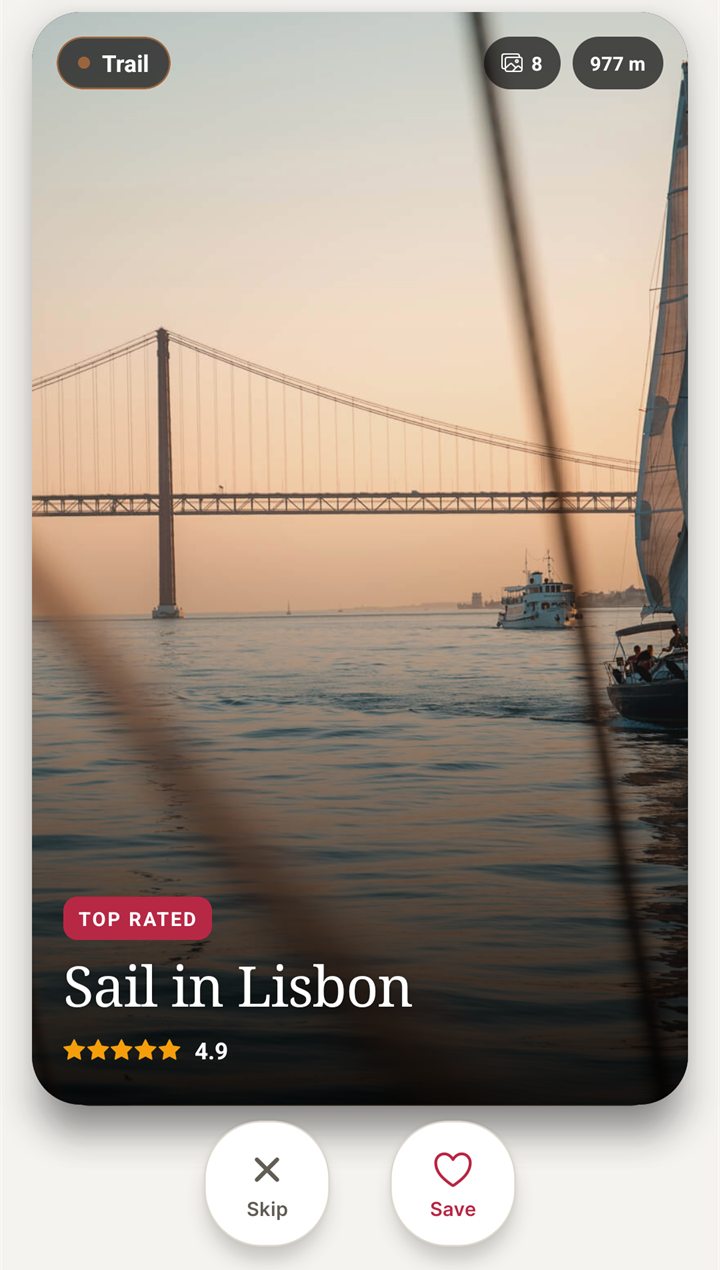
A place card with its category, distance and rating, and Skip and Save. 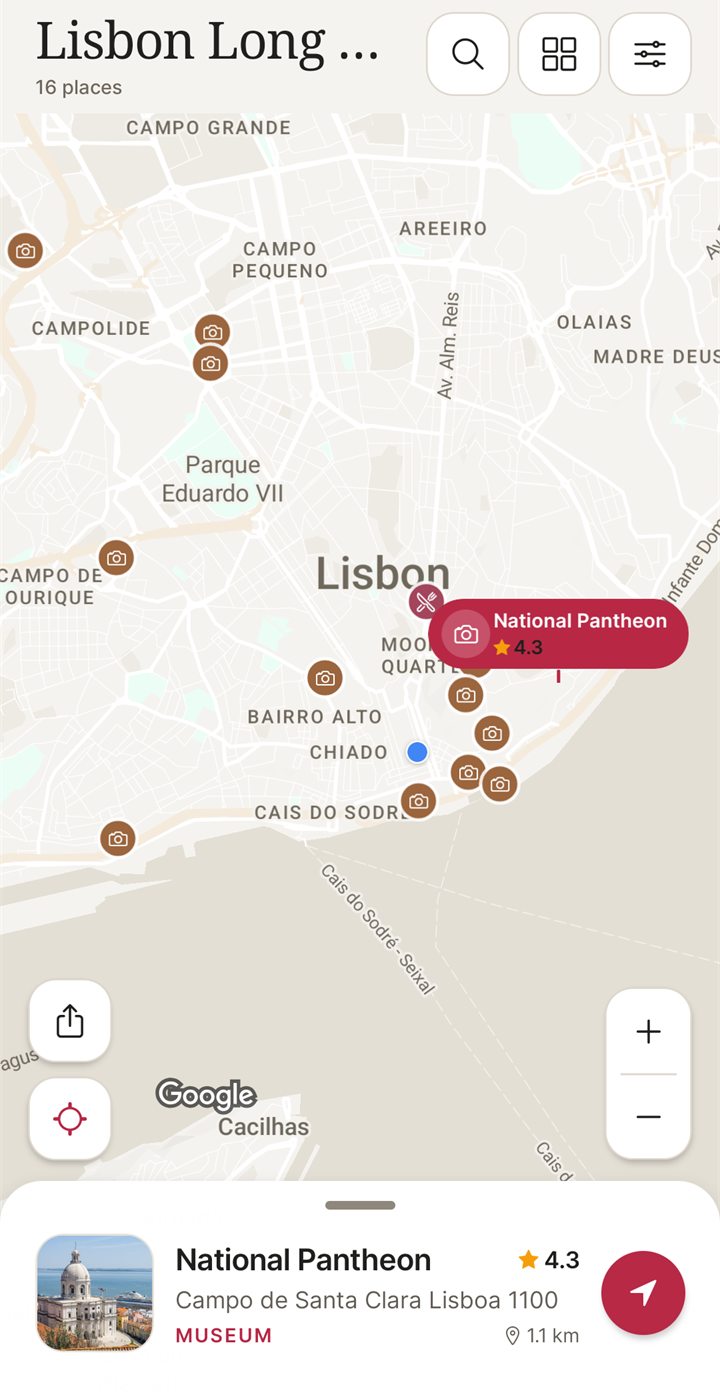
A saved trip on the map (the Lisbon sample trip from the store listing). -
Read rating with review count, then check the blanks.
A rating means little without the number of reviews behind it, and an empty rating or empty hours means unknown, not bad. Look at the unrated cards by name before you cut them, and check any card without stored hours on the place's own page. The reasoning, with Brussels numbers, is in the 7-step method. Then test each saved place against your two weekdays from step 1.
-
Open the map and cluster the shortlist into two days.
Open the trip and every saved place is pinned. A pin in the wrong country is a data slip, so drop it. The clusters show which places can share a day. The eight-step map method is in how to plan a trip on a map, and the Lisbon sample trip, 16 places picked by swiping, is walked through in Lisbon in 2 days.
-
Build the trip and pin your hotel.
Saved places are grouped by trip. You can drop a custom pin for anything not on the cards, such as your hotel, and the list sorts by rating, distance or A to Z. I did not find a day-by-day scheduler in the Google Play listing, so you put the order of each day together yourself from the map: the anchor with fixed hours first, then food nearby, then the rest. If you would rather save places elsewhere first, saving places on Google Maps works the same way for this step.
-
Book the fixed-time items first.
See the next section for the order I use.
-
Recheck hours the day before and open the trip online once.
Stored hours are a snapshot, and places change them for holidays. Confirm the stops you can least afford to miss on the places' own pages. NomadSwipe's Google Play listing says up to 20 saved trips are available offline after you open them online, so open yours once before you travel. The wording and its limits are in the offline trip planner guide. To print the result, use the printable travel itinerary template.
What to book first, and what to leave open
This order is my own judgment, not a rule from any source. NomadSwipe is not a booking tool, so none of it happens in the app.
- 1. Your bed and your transport in and out. They fix the two days you will actually have.
- 2. Anything with an entry you cannot get at the door. Check the place's own page. As one example, the Field Museum's ticket page says: "Purchase your tickets in advance to skip the line and save time!" and adds that tickets are available online and in person at the museum.
- 3. One dinner, on the night you care about most. Only if that place takes reservations, which you check on its own page.
- 4. Nothing else. Leave the swaps for closed days free. A weekend plan with every hour booked cannot absorb a closed door.
One stored value I could cross-check: the app holds the Field Museum as open daily from 9 AM to 5 PM, and the museum's own visit page says "Museum open Daily 9:00 am to 5:00 pm, last entry 4:00 pm." The page adds a last-entry time that the stored data does not have, so I would plan to arrive well before 4 PM.
Which weekend days are risky, city by city
I took the closed-day counts from the findings sections of my city guides. The percentages are shares of the places with stored weekly hours, and they mix restaurants, bars, hotels and sights.
| City | Distinct places | With stored hours | Monday closed | Sunday closed | Read |
|---|---|---|---|---|---|
| Chicago | 501 | 301 (60%) | 79 (26%) | 75 (25%) | 5 Nov |
| Buenos Aires | 684 | 364 (53%) | 93 (26%) | 90 (25%) | 5 Nov |
| Albuquerque | 459 | 315 (69%) | 73 (23%) | 80 (25%) | 6 Nov |
| Minneapolis | 497 | 282 (57%) | 66 (23%) | 75 (27%) | 6 Nov |
| Brussels | 545 | 371 (68%) | 102 (27%) | 77 (21%) | 4 Nov |
| Bruges | 464 | 291 (63%) | 84 (29%) | 49 (17%) | 4 Nov |
| New York City | 773 | 557 (72%) | 67 (12%) | 55 (10%) | 5 Nov |
| Sedona | 207 | 138 (67%) | 9 (7%) | 12 (9%) | 6 Nov |
| All eight | 4,130 | 2,619 (63%) | 573 (22%) | 513 (20%) |
Five of the eight guides state every weekday. Pooled, they give the pattern for choosing your two days.
| Weekday | Places stored as closed | Share of places with hours |
|---|---|---|
| Monday | 321 | 19.2% |
| Tuesday | 167 | 10.0% |
| Wednesday | 82 | 4.9% |
| Thursday | 38 | 2.3% |
| Friday | 19 | 1.1% |
| Saturday | 98 | 5.9% |
| Sunday | 312 | 18.6% |
Sunday and Monday are the days that cost you stops, and Thursday and Friday are the quietest. So for a Saturday and Sunday weekend, plan Sunday around places you have checked and put your most closure-prone stops on Saturday.
Worked example: Chicago on a Saturday and a Sunday
I built NomadSwipe, so this is a method run on stored data, not a trip I took. The Chicago in 2 days guide has 16 stops from the app's 501 distinct Chicago places, and its weekday table shows how they behave at a weekend. Day two, the Lincoln Park day, works on both Saturday and Sunday as written. Day one fails at the weekend on the Chicago Fed Money Museum, which is stored as closed on Saturday and Sunday, and on the Rookery Building, which is stored as closed on Sunday. So the weekend order is day one on Saturday with one swap, and day two on Sunday with none.
| Day | Start | Place | Stored hours that day | Result |
|---|---|---|---|---|
| Sat | 9:00 | Field Museum | 9 AM-5 PM | Open |
| Sat | 12:15 | Cafecito (Congress Pkwy) | 8 AM-6 PM | Open |
| Sat | 13:15 | The Rookery Building | 8 AM-2 PM | Open, closes 45 minutes after the start |
| Sat | 14:00 | Museum of Illusions Chicago (swap for the Fed Money Museum) | 10 AM-9 PM | Open |
| Sat | 15:00 | The Art Institute of Chicago | 11 AM-5 PM | Open |
| Sat | 17:30 | Jay Pritzker Pavilion | None stored | Not testable, check it |
| Sat | 18:15 | The Chicago Theatre | None stored | Not testable, check it |
| Sat | 19:15 | Sunda New Asian - River North | 11 AM-2 PM and 4-11 PM | Open |
| Sat | 21:00 | Three Dots and a Dash | 2 PM-1 AM | Open |
| Sun | 10:30 | Lincoln Park Conservatory (Reservations Required) | 10 AM-4:30 PM | Open |
| Sun | 11:45 | Peggy Notebaert Nature Museum | 10 AM-4 PM | Open |
| Sun | 13:15 | Cafecito (Fullerton Pkwy) | 8 AM-8 PM | Open |
| Sun | 14:30 | Chicago History Museum | Noon-5 PM | Open, 2.5 hours left |
| Sun | 16:30 | Oz Park | 6 AM-11 PM | Open |
| Sun | 18:30 | Cafe Ba-Ba-Reeba! | 10 AM-9 PM | Open |
| Sun | 20:30 | King of Cups | 5 PM-2 AM | Open |
The swap is the Museum of Illusions Chicago, stored as a museum at 4.2 from 280 reviews and 0.60 km from the Rookery by stored coordinates. This weekend variant is checked by hand against the stored hours quoted in the Chicago guide, not re-run through the script. The Pavilion and the Theatre have no stored hours, so their rows are not tested. If your weekend is Friday and Saturday instead, the Chicago guide says day one then day two works as written. The Chicago guide has the Art Institute stored as closed on Tuesday, which is why a Tuesday trip needs a different swap. Every number above is a stored value and may have changed since.
The same exercise works in any deck. For another weekday pattern, compare Buenos Aires in 2 days, where Thursday to Sunday all work, or Minneapolis in 2 days.
What a weekend cannot hold
- More than two neighbourhoods. My two-day guides keep each day in one area. A third area costs a travel leg you do not have.
- Sights the deck does not have. Every deck I have read lacks some famous names, so add your own pin for the one you came for and check its hours yourself.
- Prices and transit times. I did not source them for this page. Check each place's own page.
- Day-by-day scheduling in the app. NomadSwipe gives you the shortlist and the map. The order of the day is yours.
Questions about planning a weekend city break
How many places should I plan for a weekend city break?
The 2-day guides on this site use 14 to 17 stops, counting meals and a drink or two: 16 in Chicago, 14 in New York City and 17 in Las Vegas. That is my own choice, not a rule. If your shortlist is longer, keep the extra places as swaps for a closed day, not as extra stops.
Which days are best for a weekend city break?
Friday and Saturday carry the fewest surprises. In the five NomadSwipe city decks that state every weekday, 98 of 1,675 places with stored hours (6%) show Saturday as closed, against 312 (19%) for Sunday and 321 (19%) for Monday. In Brussels, 11 of the 18 museums with stored hours show Monday as closed. Check the specific stops you want.
What should I book first for a weekend city break?
Book your bed and your transport in and out first, then anything with an entry you cannot get at the door, such as a ticketed museum or a restaurant you will only visit once. Leave everything else unbooked. NomadSwipe is not a booking tool, so this step happens on the places' own pages.
Does NomadSwipe plan the days of a weekend for me?
No. The NomadSwipe Google Play listing describes swiping, saving, a map and a list sorted by rating, distance or A to Z, and I did not find a day-by-day scheduler in it, so you order each day yourself from the map. NomadSwipe is Android only today, and iPhone is coming soon.
Can I plan a weekend city break with Google Maps lists?
Yes. Google Maps Help describes saving a place to a list: search for it or tap it on the map, tap its name or address, tap Save and pick a list, and a list can be Private, which only you can view and edit. The steps are in how to save places on Google Maps for a trip.
Build your weekend shortlist
I built NomadSwipe to swipe real places in a city, save the ones you like and see them on a map. It is Android only for now, and iPhone is coming soon.
Findings, method and sample
Sample and method. I read the closed-day counts from the findings sections of eight of my published city guides: Chicago, Buenos Aires, Albuquerque, Minneapolis, Brussels, Bruges, New York City and Sedona. Each guide read the NomadSwipe app's place data with read-only queries on the date in the table (4 to 6 November 2026) and states its own method for distinct places and the city box. I added the counts across guides and computed every percentage here myself, with places that have stored weekly hours as the base. Five of the guides state all seven weekdays and form the pooled weekday table. Minneapolis, Brussels and Bruges state only Monday and Sunday, so they appear only in the first table. I re-ran no queries for this page.
- The eight decks hold 4,130 places, and 2,619 of them (63%) have stored weekly hours. Coverage runs from 53% in Buenos Aires to 72% in New York City.
- Of the places with stored hours, 573 (22%) show Monday as closed and 513 (20%) show Sunday as closed. Sedona is the low outlier, with 9 and 12 of 138, and New York City is next, with 67 and 55 of 557.
- In the five decks that state every weekday (1,675 places with hours), the closed counts by weekday are Monday 321, Tuesday 167, Wednesday 82, Thursday 38, Friday 19, Saturday 98 and Sunday 312. Saturday is 5.9% and Sunday is 18.6%.
- In the Brussels deck, 11 of the 18 museums with stored hours show Monday as closed, and in Bruges 9 of 17 museum cards do.
- In Chicago, the weekend order works with one swap on Saturday and none on Sunday. The Fed Money Museum is stored as closed on both weekend days, the Rookery as closed on Sunday and as closing at 2 PM on Saturday.
- One cross-check: the Field Museum's stored hours (daily 9 AM-5 PM) match its official visit page, which also gives a 4 PM last entry. I did not read the official pages of the other stops, so the rest of the stored hours are unchecked.
- The two-day guides on this site use 14 to 17 stops (New York City 14, Albuquerque, Minneapolis and Sedona 15, Chicago and Buenos Aires 16, Las Vegas 17).
Limits: the decks are mostly US cities, plus Buenos Aires and two Belgian cities, so other places may differ. The percentages pool restaurants, bars, hotels and sights, and a closed day for a bar matters less than one for a museum. Stored hours are snapshots, and I did not re-check them against the places' own pages except the Field Museum. A deck holds only the places the app has, so absent landmarks are not counted. Closed-day patterns also change on public holidays. I left out prices and transit times and did not copy any third-party review text.
Sources
- Place data: the NomadSwipe app's stored place data for the eight cities, as published in the city guides linked above, read 4 to 6 November 2026. No third-party pages were used for the counts.
- Field Museum, visit page (hours): https://fieldmuseum.org/visit (read 6 November 2026)
- Field Museum, tickets and pricing (buying tickets in advance): https://fieldmuseum.org/landing/tickets-and-pricing (read 6 November 2026)
- Google Maps Help, create a list of places: https://support.google.com/maps/answer/7280933 (read 6 November 2026)
- NomadSwipe facts: the public Google Play listing of NomadSwipe: Trip Planner (swipe, save, map, list sorting, offline wording) and the NomadSwipe home page, checked 2 to 6 November 2026.